
 About Us
 Contact
 Subscribe

 News
News Reviews
 Features
 Columns
 Podcast


EDIT: Check out Evan's photos from the convention in the Flickr slideshow below! Ink's are available right here.
Click here for more of our AnimeNEXT 2011 coverage
Continue reading... | Write a comment


|
Con Report: AnimeNEXT 2011 (EDIT: now with more pictures!) |
Continue reading... | Write a comment


|
Revenge of the iPad Video Game Review Round-Up |
Have an iPad? Want to play games on it? Don't want to throw your money around the app store like a madman in search of a decent purchase? You've come to the right place, my good friend! Pull up a chair and I'll give you some more rapid-fire reviews of iPad games!
($0.99 – US App Store link – UK link)
iPowa was released with zero fanfare onto the App Store, and I picked it up day one on a whim. It’s an endearing little puzzle game where you flick a tiny penguin around the screen to collect stars, using bubbles that act as launch pads and various randomly placed power ups to keep from falling off the bottom of the screen and ending the game. There is no overacting structure or plot line, just a fun little time waster with a global scoreboard and infinite replayability due to its randomly generated levels. iPowa has given me hours of enjoyment playing it on the bus, and the low price even includes an iPhone port in case you own one of those as well.
($5.99 – US App Store link – UK link)
War of Eustrath is a turn-based strategy RPG which very closely follows the mold of Super Robot Wars and Fire Emblem. You control a small number of very powerful but specialized mechs and get thrown into pitched battles against hordes of other mechs as ... you do something or other. I have to admit that while the world is well realized, the plotline is instantly forgettable and I often found myself skipping past the character conversations between battles. This is not entirely the fault of the plot itself — in fact it is quite interesting — but it is horribly copyedited and reads like a Google-Translated version of the original script. Putting this aside, the combat itself is very enjoyable and well balanced except for a few brutal encounters that you will have to throw yourself at over and over again to get past. There is a robust leveling and customization system, as well as multiple plot paths and endings that depend on your choices and how well you play. A rather pricey offering, this game is still well worth a look if you are a fan of strategy games. You may want to wait for an update if you can’t stomach Engrish, though.
NOTE: Since this review was originally written a major patch has been released that corrects many of the problems with the script. The story is still inconsequential, but at least now it is in legible English!
($4.99 – US App Store link – UK link)
Remember the first iPad game article, where I reviewed Strategery, a game much like Risk but not quite? Well, Dominion is a straight-up clone of the modern rule set of Risk with a cleaned up visual aesthetic. If you have ever played the wonderful nuke-em-up game Defcon you will recognize the clean, faintly glowing look instantly. The AI is a bit dense and so the single-player mode is best used as an extended tutorial beyond the basic one provided, or as an exhibition mode to view the different maps provided. Multiplayer is where the meat of the game lies, especially at the time of writing as the game has a dedicated player base viewable via the game browser. There is one glaring oversight however — if, on the first time you start the app, you turn off Push notifications, you are unable to enable them later on. Due to this I now have an abysmal online record as I have no idea when I am supposed to take turns in the games I have signed up to. One upside is that the game is updated frequently with new maps and other goodies, something that looks likely to continue in the future, even if the additions are nothing earth-shattering.
($7.99 – US App Store link – UK link)
This is going to date me, but this game is an awful lot like the old spacefaring game Elite. You are given a spaceship, dumped into an open map, and it's up to you to trade, shoot and mine yourself to the top of a dog-eat-dog galaxy. Sadly, Warpgate does not quite live up to the comparison, as the whole thing feels disappointingly sterile. Even in hostile areas where the locals want your head on a space-pike, things feel very empty and inconsequential. The tutorial plot chain drags out endlessly, both by screen after screen of empty dialog and by the clunky menus and interface. Combat feels almost random and it is hard to intuit if you are succeeding or not, or even if strategy would help more than simple button mashing. All of this is a shame as behind all these clunky elements is a well-constructed core with an interesting universe to explore. Sadly it is slathered in a thick layer of gloop that makes the game unpleasant to play, even excepting the frequent crashes. I would still recommend trying the Lite version if space exploration is your cup of tea, after all inscrutable interfaces are almost a point of pride for the genre at this point. In all seriousness, you may find yourself in love with it and able to overlook the flaws in favor of the depth of experience on offer here.
($7.99 – US App Store link – UK link)
I must admit that I am rather fed up with tower defense games, and unless they do something exciting I tend to tire of them quickly. Tweet Defense’s gimmick is that it links to your Twitter account and changes gameplay variables based upon the status of your account. In particular there is a "booster" function where you get a large buff for following a particular account each day. An important thing to note here is that one of the driving forces behind the game is a marketing firm and so this particular game mechanic feels rather invasive and unsettling. But never mind all this, how does the game play?
Well, poorly. First off, the game is bloody ugly. The general design is not very pleasing to the eye and without a spark of originality. The game plays out at a painfully slow pace and it is worth noting that it is a great deal harder if you eschew the Twitter account linking, making this slightly unsavory feature a must to actually play the game. I was honestly hoping for a more inventive use of the Twitter association, such as having enemies or towers procedurally generated by incoming tweets.
I only downloaded this game because it was free for a day, and even for free it feels like a waste of time. The original price of $8 sounds like daylight robbery. Avoid.
($1.99 – US App Store link – UK link)
This is a bit of a cheat, really. Uzu is not a game, but an experience. It calls itself a "kinetic multi-touch particle simulator" and that's exactly what it is. You tap the screen with one or more fingers and a sea of multicolor particles whirl around the screen in various patterns and motions much like an interactive music visualizer. The effect is amazingly entertaining, and heightened by listening to good music at the same time. I have lost an hour of my life so far playing with the app while utterly enraptured by it. Plus, it's a dollar. I've paid much more than that before for less entertainment, like when I saw Transformers 2 in the cinema. Get this now, and amaze your friends with it.
(Free – US App Store link – UK link)
I have a theory as to why this game exists. It goes like this: Developers NGMoco took one look at Farmville and the other Facebook free-to-play micro-transaction games and said, "hey we should get in on that too!" The result is a rather daft-looking clone which is more abrupt at demanding you pay money for features and blackmailing your friends into signing up as well, cutting short the tutorial into what could have been an interesting fantasy kingdom sim. The game has an irritating tendency to crash, and this coupled with an utter lack of charm and the horrendous loading times meant that I found it hard to be bothered with playing after my second session was abruptly ended. If you must play a time-sink game, you would be better off playing a more established and well-known example.

iPowa

War of Eustrath

Dominion HD

Warpgate HD

Tweet Defense HD

Uzu

We Rule
Continue reading... | Write a comment
|
|
Zenkaikon 2011: Giant Robot Openings from 1963 to 1984 |
Not having a particular interest or background in giant robot anime, I would probably be the last person you’d expect to see at this panel. However, a panel I attended last year at Otakon provided some insight into the creation, production, and subtext of oft-ignored credit sequences, so I decided to see what there was to be said about this specific evolution. Starting with Astro Boy and ending with something pre-1984, the panel consisted of one un-subbed opening sequence after another (roughly 42 by my count) without the benefit of any explanations, explorations, or even names. After one of the presenters hit play on the laptop, the audience was left to marvel at one- to two-minute clips in rapid and seemingly infinite succession for almost the entire hour.
Despite being irked at the lack of introduction and discussion, I initially fell into a state of humored awe. There’s just so much giant robot anime out there ... and the panel didn’t even reach its end! No wonder there wasn’t any time for intros (as frustrating as that was). After 10 or so openings, however, I felt a wearing tedium akin to being accosted by a friend whose notion of in-person entertainment is the sharing of endless Internet memes. While thorough in their acquisition of material, the panelists could’ve made a go of being more selective by grouping openings into trends and showing one example per group per time period and then discussing possible reasons for the noticeable differences.
After coming to terms that there would be no explanations, I sat back and tried as adeptly as possible to discern the evolutionary path myself. There was more than enough on which to comment, but among the things I found fascinating was the gradual swing in focus from violence to teamwork as saving grace. Within even this over-simplified observation there is much to expand upon: operator interaction with singular robots in the various recurring violent and teamwork eras, focus on detailed technological aspects of the robots themselves, form, weaponry, setting, fictitious and real word historical framing, etc. Alas, with but a minute or two of fury to note so many aspects, I simply put down my pen and enjoyed the relentless onslaught of visuals with the rest of the lip-syncing, bouncing crowd. And for the first panel on opening day of the con, maybe that’s all I needed.
Credit goes to yosefu2 for posting all the above clips to YouTube.
Click here for more of our Zenkaikon 2011 coverage
Continue reading... | Write a comment
|
|
Con Report: Zenkaikon 2011 – Room to Grow In |
Continue reading... | Write a comment
|
|
2010 Staff Picks: Elliot |

For the five days leading up to the New Year, Ani-Gamers is posting an un-ranked list of our favorite titles from the year 2010, featuring up to two choices from each writer. Be sure to check back throughout the week to find out what geeky stuff our contributors really dug this year! We now present the choices from manga and video game reviewer Elliot Page.
Demon’s Souls (From Software): While this came out in the US in 2009, its only this year that Europeans like myself have had the pleasure of being humiliated by the ruthless gaming experience that is Demon’s Souls. There are just so many things that make me love this game — the atmosphere in particular. The ravaged, demon-filled lands of Boletaria and the few people who still cling to life set an excellent tone for your character’s adventure, making you truly feel like the last hope for the world. Not that saving the world is an easy task — the game’s controller-smashing difficulty is well documented, but it never feels punitive. This, combined with the tight direct-action combat and lack of hand-holding, makes playing the game all the more satisfying, especially when you kill a major demon. I barely have time to mention the game’s amazing online system, where players can leave notes for each other as advice or enter another player’s game to either assist or antagonize them. Plus, Demon's Souls has buckets of re-playability due to the breadth of character options available, and the fact that you will grow to love the pain the game inflicts.
Bayonetta (Platinum Games/Nex Entertainment): It’s hard to come up with a fitting opening line to fully encompass the wonder that is Bayonetta, but here goes: Bayonetta is a game where you play a nine-foot-tall woman who wears clothes made out of her own magical hair, has control over time, can summon massive demons, and spends her time destroying hundreds of freakish angels in order to do something or other. I don’t remember the plot very well — while hilarious and a great way to string the action together, it is so insane that your mind rejects it the second you stop playing. Bayonetta is what is known in the trade as a “Character Action Game” — somewhat like Devil May Cry, God of War, that sort of thing. That means a third-person camera, a combo system using different weapons including ground and aerial moves, quick time events, and button-mashing special attacks. Except, Bayonetta is the only game of this genre I have enjoyed, let alone completed twice over. The controls feel so tight and accessible, saving you from being constantly being reminded that there is a plastic knob in between you and the game. The game also has a great sense of fun all over, in its level design, enemies, and weapons. (Even the in-game shop will make you crack a smile when you visit.) The sheer amount of love put into the game shines through especially well in the final levels, during which I could not stop grinning for the entire two-hour session.
A side note: make sure to play the Xbox 360 version of this game, as the PS3 version has some horrible loading issues that rapidly suck the fun out of it.
Extra Bonus Item! (Likely to annoy Evan! This is done in the name of beefing out the amount of anime in the year-end picks.)
Baccano! (Brain’s Base): Seriously, go and read my Anime Secret Santa post on this series. After reading it, it should come as no surprise to learn that as soon as I had moved into my new house I unpacked Baccano! to re-watch it. To be precise, it was the fifth thing I unpacked, coming after the sofa, the DVD player, the TV and the kettle (for tea, of course). My love for this series only grows as I watch it this second time, and I heartily recommend it. (Ed. Note: Baccano! was released in the UK during 2010.)
Baccano! is also recommended by Ani-Gamers editor Evan "Vampt Vo" Minto.
See Also:
Continue reading... | Write a comment

|
2010 Staff Picks: Evan Krell |

For the five days leading up to the New Year, Ani-Gamers is posting an un-ranked list of our favorite titles from the year 2010, featuring up to two choices from each writer. Be sure to check back throughout the week to find out what geeky stuff our contributors really dug this year! We now present the choices from video game reviewer Evan "BakaTanuki" Krell.
Durarara!! (Brain’s Base): This oddball show is a bit hard to describe within a few sentences. In fact, even naming the protagonist is complicated with so many characters and plot threads. From the director, studio, and original author of Baccano!, Durarara!! is rather similar, as it is built upon a huge and interesting cast of characters, their interactions, and how their own stories all intertwine into the overall weirdness of Tokyo's Ikebukuro district. The series begins with a high schooler from the country moving into Tokyo, and leaves the impression that it will be about his experiences with his new surroundings and how he will be become involved in them. While not completely inaccurate, everything in Durarara!! has some sort of twist to it — often many. Later episodes introduce and focus on other characters, and eventually these pieces all begin to fit into the puzzle. There is a ton going on in this show, and keeping up with it all is part of the fun. Things can get pretty convoluted, but the atmosphere is laid back and fun enough to not really worry about it. Durarara!!'s urban fantasy setting makes little attempt (if any) to stay grounded in reality, and it manages to pull of some over-the-top fantasy played completely straight. The visuals are all quite distinctive with a certain dark-urban aesthetic to it. The music is also very good with both jazz and rock elements throughout. Durarara!! is extremely enjoyable, and I was thoroughly captivated with it as I followed it through Crunchyroll's simulcasting. Despite only being released this year, I am currently on my third viewing and keep finding more to love about it.
Durarara!! is also recommended by Ani-Gamers editor-in-chief Evan "Vampt Vo" Minto and contributor Ink.
Twin Spica (Kou Yaginuma): This story of a young girl pursuing her dream of becoming an astronaut is easily the best manga I have read this year. Asumi, a 13-year-old girl, has always wanted to be an astronaut like her mother was. The interesting thing about this goal is that her mom died in a rocket accident when Asumi was a baby. Twin Spica is a character drama at its core, as Asumi has to deal with various relationships with others as well as her own personal development. As expected, her father has trouble supporting her ambition to follow the career that lead to his wife's death, and she has to deal with a group of new classmates at the space training academy. There is also a mysterious boy with a Lion mask on that appears to be a figment of Asumi's mind. Twin Spica tells a heartfelt story with an extremely likeable lead. Asumi is very sweet, but has more depth than the typical cutesy anime girls. The astronomical elements add a realistic science fiction aspect to the story that enriches the experience without becoming tacked on “sci-fi.” The artwork is simplistic, but becomes more refined as the artist, Kou Yaginuma, progresses. Twin Spica has four volumes out and is off to a strong start. I find it to be an extremely compelling read, and another great release from Vertical, Inc.
Twin Spica is also recommended by Ani-Gamers editor-in-chief Evan "Vampt Vo" Minto.
Continue reading... | Write a comment

|
2010 Staff Picks: Vampt Vo |

For the five days leading up to the New Year, Ani-Gamers is posting an un-ranked list of our favorite titles from the year 2010, featuring up to two choices from each writer. Be sure to check back throughout the week to find out what geeky stuff our contributors really dug this year! We now present the choices from editor-in-chief and podcast host Evan "Vampt Vo" Minto.
Mass Effect 2 (BioWare): When I first started hearing the video game press rave about Mass Effect 2, I knew I had to finally sit down and play the original Mass Effect. It turned out to be just about as disappointing as the reviews made it out to be — a fun ride chock full of potential that doesn't always deliver. Mass Effect 2, on the other hand, fixes nearly every glaring problem with the original game. That's not to say it's perfect, but it's hard not to enjoy this interplanetary heist story, with its quick-paced action scenes, satisfying leveling mechanic, huge catalog of background data on the game world, and endlessly entertaining cast that sticks with you long after you've put down the controller. Mass Effect 2 is some of the finest gaming I've had in a long time, and if you're at all a fan of sci-fi or RPGs, this is the game to pick up this year.
Mass Effect 2 is also recommended by Ani-Gamers contributor Elliot Page.
Ayako (Osamu Tezuka): While Japanese readers were introduced to Ayako in January of 1972, Osamu Tezuka's classic work of historical fiction arrived in the English-speaking world just this year, courtesy of publisher Vertical, Inc. and translator Mari Morimoto. Fans of the so-called "god of manga" (known for Astro Boy and Black Jack) will find him at his darkest point yet, as he weaves a dramatic yarn of deceit and suffering, set in post-war occupied Japan and centering around a young girl trapped by her own family in the storehouse cellar for 23 years. Despite its whopping 704-page single volume, Ayako is a gripping tale from start to finish, sure to leave even the most steadfast of Tezuka fans drained by the time they reach its powerful conclusion.
See Also:
Continue reading... | Write a comment
|
|
2010 Staff Picks: Ink |

For the five days leading up to the New Year, Ani-Gamers is posting an un-ranked list of our favorite titles from the year 2010, featuring up to two choices from each writer. Be sure to check back throughout the week to find out what geeky stuff our contributors really dug this year! We now present the choices from reviewer and columnist Ink.
Ed. Note: We miscalculated the number of contributions we would be receiving from our writers, so we won't be following a one-a-day schedule from this point on. Sorry!
Fable III (Lionhead Studios): What this third incarnation of the Fable franchise does so completely that the former installations do not is create a truly immersive and believable world in which its main character's participation is only a piece of the proverbial pie. It accomplishes this by forsaking the isolated, hero-centric approach of old and broadening the story's focus and consequences to include the needs of all the people around the hero — intimately and in a broader sense. As people in our world continue to grow increasingly isolated from one another, Fable III illustrates how many lives the actions of one person can affect and also serves as a reminder to step into others' shoes before judging their actions. As a poet, I can think of no better video game execution of Shelley's sympathetic imagination.
House of Five Leaves (Manglobe): Though focused on a group of thieves and a lone ronin, House of Five Leaves is less about action than growing to understand personal reasons behind past actions and present conditions. The main character is a samurai turned woebegone bodyguard who is hired into a den of thieves that kidnaps people for ransom, under the auspice of humanitarianism. The art is a bit jarring at first, with fish-like faces adorning otherwise realistically drawn bodies, but there's no denying the animation's beauty via color contrasts and use of darkness or its direct reflection of the story's pacing, which is slow and utterly character driven. All the above characteristics contribute to the sense that this is not an anime aimed at kids but rather the adult viewers of the noitaminA block in which it appeared.
See Also:
Continue reading... | Write a comment

|
2010 Staff Picks Day 2: Sean |

Once a day for the six days leading up to the New Year, Ani-Gamers is posting an un-ranked list of our favorite titles from the year 2010, featuring up to two choices from each writer. Be sure to check back throughout the week to find out what geeky stuff our contributors really dug this year! We now present the choices from copy editor Sean Kim.
Super Meat Boy (Team Meat): Mind-numbingly difficult, yet surprisingly refreshing, Super Meat Boy manages to capture what truly makes a good platformer. It truly defines the masochistic style of game design, in a similar vein to other indie 2-D platformers: N+, Jumper, and I Wanna Be the Guy, to name a few. Everything about the game is polished, from the sounds that Meat Boy makes as he squishes his way through the levels to the beautiful and often varied environments. The gameplay is spectacular; not only does Meat Boy handle extremely well, the levels are designed with an amazing amount of detail to allow for an exhilarating rush when timing all the jumps perfectly. Make no mistake, though, this game is hard, and I wouldn’t recommend it to everyone. I found myself cursing at the TV on multiple occasions when dealing with some particularly challenging levels. If this type of game sounds interesting, you owe it to yourself to get Super Meat Boy. It is currently on sale for 800 MS points on the 360 and $7.49 on Steam for the PC (Mac version to be released in the coming months)
Super Meat Boy is also recommended by Ani-Gamers contributor Ink.
Recettear: An Item Shop’s Tale (EasyGameStation): Capitalism Ho! Recettear: An Item Shop’s Tale was certainly a surprising hit this year. The premise for the game is simple: you owe a lot of money and need to make it back through market manipulation and dungeon crawling. The gameplay is fairly basic at its core, but offers many different characters to explore various randomly created dungeons in search of fame and fortune. The item shop portion of gameplay takes a bit of getting used to, as the deadlines are a bit harsh, and the amount of options available to wisely spend your time and manipulate the market can make one’s head spin at first, though all these concepts are slowly introduced, as to provide a continual challenge throughout the game. Much of the game’s charm comes from the character interactions and dialogue. I often found myself laughing out loud at many situations, something rare in games these days. If you’re looking for a different kind of RPG, you should pick up Recettear, currently on sale on Steam for $9.99 for the PC.
Continue reading... | Write a comment

|
2010 Staff Picks Day 1: Mehket |

Once a day for the six days leading up to the New Year, Ani-Gamers is posting an un-ranked list of our favorite titles from the year 2010, featuring up to two choices from each writer. Be sure to check back throughout the week to find out what geeky stuff our contributors really dug this year! We now present the choice from video game reviewer Hayley "Mehket" Myer.
Dante's Inferno (Visceral Games): Mixing classical literature and video gaming technology doesn’t sound like the greatest of ideas, but Visceral Games and Electronic Arts do an amazing job portraying Dante’s journey in The Divine Comedy as hetravels through the nine layers of Hell. The game follows the epic poem with a surprising amount of precision, depicting characters and each level of Hell as accurately as possible. The people Dante meets in the poem are scattered throughout Hell, and the ability to absolve or punish them for their worldly crimes allows the players a brief moment to play God, reflecting on their own virtues and morals. While there are some deviations in storyline, there is much to learn about The Divine Comedy from the otherwise brutal, graphic game, including dialogue from Virgil, Dante’s guide, and the cantos shown to players each time they are defeated by Hell’s minions. The game is not for the faint of heart, as it sticks to the gore and fear that Dante inspired throughout the poem, but for those who like a bit of education in their video games, Dante’s Inferno is a necessity.
Click here for all the 2010 Staff Picks posts.
Continue reading... | Write a comment
|
|
MMF: One Piece – A Love Story in Two Acts |

This month, the Manga Moveable Feast (or MMF) focuses on Eiichiro Oda's smash-hit shōnen manga series One Piece, and since I own 13 volumes of the wacky pirate action-adventure, I decided to contribute to the project. However, I've got a rather odd admission to make: I don't read One Piece anymore. In fact, I haven't read even a single new page of the manga since the spring of 2008.
Make no mistake, though, One Piece is actually one of my favorite manga of all time. Nearly three years ago, I simply stopped reading the books, and I have not reneged on my decision since then. In part because of this decision, and in part because of the series' instrumental role in introducing me to manga, One Piece has retained a very unique place in my heart.
My introduction to One Piece hardly has any of the nostalgic glory of old-time anime fans' origin stories, as it starts sometime in 2003 or so (right in the heart of the mid-2000s manga boom). One of my middle school teachers passed out a Scholastic book catalog, and in it, glaring at me with all his silly intensity, was Yugi Moto from Yu-Gi-Oh! It was an issue of Viz's Shonen Jump, on sale in my school's catalog!

Naturally, after my experience with these cool Japanese cartoons on Cartoon Network's Toonami block (a frequent stepping stone for mid-'90s anime fans), I was excited to get my hands on the mysterious black-and-white comic book versions of the stories. Though I was hardly a fan of Yu-Gi-Oh! as a series, I was instantly hooked by two manga running in the magazine: Naruto and One Piece. They particularly grabbed me because I had never seen anime versions of them, unlike most of the titles in Shonen Jump.
Shortly after my first time reading One Piece (somewhere in the middle of Volume 2's Buggy Arc), I scrambled to pick up as much manga as I could get my hands on. I picked up the first two volumes of the terrible .Hack//Legend of the Twilight and received One Piece Volume 2 for my birthday. And with that, I was officially a fan of rubber-man Monkey D. Luffy and his crew of oddball pirates.
As a child of the Dragon Ball Z generation, I really felt a connection to Oda's Toriyama-inspired characters, stories, artwork, and sense of humor. Everything in One Piece, from the fights to the characters' dreams, is exaggerated, filled with a passion unparalleled by the actions of real people. For a wide-eyed middle school kid, new to the vast world of anime and manga lurking under the Toonami-glazed surface, Oda's powerfully kinetic yet inherently accessible work was just the kind of thing to propel me into full-fledged fandom.
And propel me it did! 2004, the year that marked my post-One Piece anime/manga obsession, also marked the creation of an overly ambitious little anime fan site called Anime Paradise, which would later become the Ani-Gamers you see today.

It's pretty clear at this point that One Piece is one of the defining works of my personal manga fandom, but why did I stop reading it after all the passion I had invested into it? It's very simple, actually.
At AnimeNEXT 2008, I pushed my way to the nearest manga vendor and started rifling through the books on the table. As I had done for the past few years, I picked up the latest volume of One Piece (14 in this case) and got ready to buy it. But then it hit me. Looking at the volumes on the table, I took note of the books that I would then have to buy after Volume 14. I thought it over in my head — "One Piece isn't even finished yet in Japan, let alone in the US. Heck, I don't even know when this Baroque Works Arc is going to end. It could be ten more volumes for all I know!"
So, on that day, I made the fateful decision, on behalf of my wallet, to stop buying One Piece. Of course, since I am strongly opposed to manga piracy (har har), reading it online is out of the question, so that means I effectively decided to stop reading the series, period. Since then, Viz Media's American run of One Piece has reached 55 volumes, and it still hasn't ended in Japan. After re-reading the volumes I bought years ago, I really miss the Straw Hat Pirates and all their crazy adventures, but the prospect of restarting my collection is a daunting one.
Indeed, that's the ultimate tragedy of the paying fan of any long-running, ongoing manga series; continued dedication to your favorite story requires an inordinate amount of money and shelf space. Nevertheless, the boundless motivation of Luffy and his comrades serves as a reminder of the importance of doing what you love, regardless of the obstacles in front of you. Who knows? Maybe one day I'll finally follow Oda's wisdom, pick up One Piece Volume 14, and start this old journey up once again.
Continue reading... | Write a comment
|
|
Preview: Black Butler (Dub) |

Ahh, Black Butler, also known as "Kuroshitsuji" in Japan. Infamous for its perpetually squealing teenage girl fanbase, it can be difficult for male fans to actually give it a try. However, after my stint with the surprisingly funny Axis Powers Hetalia (also known for its prepubescent female fans), I thought I might as well give Black Butler from A-1 Pictures (Kannagi, Welcome to the Space Show) a fair shake.
In the two dubbed episodes that I received on FUNimation's preview disc, however, I found myself giving Black Butler much more than a fair shake. You see, this series is in fact a shōnen (boys) manga, even though it clearly aims for a female demographic with its pretty-boy main characters and vaguely homo-erotic situations. This combination of demographics, now quite common in the manga world, means that Black Butler can provide an experience that's fun for more than just the core girls audience. Go figure!
Sebastian is a demon butler, bound to his master, Ciel Phantomhive, by a devilish contract — he must obey all of his master's orders, but Ciel has also agreed to allow Sebastian to consume his soul after the contract has ended. Following along with this delightfully Faustian setup, the series is defined by a dark, gothic style, complete with classic ornamentation in both architecture and fashion.
Plus, FUNimation's dub uses some surprisingly accurate British accents to help geographically and historically place the story in Victorian England. The voices don't always work — namely Brian Mathis, who weaves in and out of an Italian accent for the villain of episode 2 — but even some of the weaker performances like Monica Rial's Cockney accent manage to produce moments of comedy.
These two (predictably) self-contained episodes center around Sebastian's dazzling butler abilities, as he shows up all of the manor's servants with his masterful preparation of dinner and ... fighting prowess. In fact, the inclusion of fight scenes highlights the most important thing about these first few episodes of Black Butler — they combine straight-up visual gags with black comedy, creepy gothic macabre, light drama, and A-1 Pictures' best imitation of BONES-style (Fullmetal Alchemist) action scenes. The result is a fun, creepy, and exciting pastiche that never leaves you without a dull moment, despite its tendency to careen between styles.
Granted, this is just based on a limited preview, so the show could easily let me down after more than two episodes. Regardless, the beginning of Black Butler is undeniably entertaining; it may feature a pretty-boy butler being pretty, but his Golgo 13-esque ability to effortlessly complete any task, no matter how gruesome, makes for fun times, and the variety of comedic styles is sure to please nearly anyone.
Look for Black Butler on DVD from FUNimation Entertainment on January 11, 2011, and check it out with English subs right now on FUNimation's video portal, Hulu, and Anime News Network.
This preview is based on a complimentary screener DVD provided by FUNimation Entertainment.
Continue reading... | Write a comment
|
|
Con Report: New York Comic Con vs. New York Anime Festival vs. You (2010) |
It's hardly a secret that anime fans are often driven to their fandom by their desire to be a part of something "different." It's one of the primary reasons that anime fans tend to be so much younger than fans of other media. So, what's the most logical thing for Reed Expositions to do with their successful New York Anime Festival, which has been running as the dominant New York-area anime convention since 2007? Obviously, merge it with pop culture mega-event New York Comic Con, where anime fans can finally be integrated with American comic book readers, cartoon fans, sci-fi geeks, and all other manner of nerdy folks. A little counter to the wishes of most anime fans? You bet!
This year, Reed rented the entire Jacob Javits Center, providing a positively massive space for all sorts of panels, events, and dealers. The entire top floor was dedicated to a series of exhibitor halls, featuring everybody from indie comic artists to small press to comic dealers to massive video game companies. Meanwhile, the bottom floors featured dozens of panel and video rooms, the IGN Theater (for large screenings), and — as I dubbed it upon my first visit — the "anime ghetto."
It almost seems like Reed was trying to have it both ways: get the anime fans to come to New York Comic Con without making them feel like they're "just like everybody else." The result? The anime segment was shoved off to the hallway on the south side of the convention, where attendees could go to find the anime panel rooms, maid café, and "Anime Artist's Alley" (yes, completely separate from the Real Artist's Alley).
This setup doesn't make any sense for anyone involved. Clearly regular Comic Con attendees, who tend to skew a little older, don't want to be surrounded by squeeing, glomping anime fans, which explains the implementation of the ghetto. If so, though, why combine the two cons? Surely not for the convenience of anime fans having access to both anime content and comic/game/etc. content, since fans interested in more than just anime would just be attending the all-inclusive Comic Con in addition to (or instead of) the Anime Festival. And the non-anime fans don't gain anything by the addition of anime fans except more people and booths to take up space in the Exhibitor's Hall. It would seem that the only reason for the integration was to save money on running two separate, annual conventions in the exorbitantly expensive Javits Center.
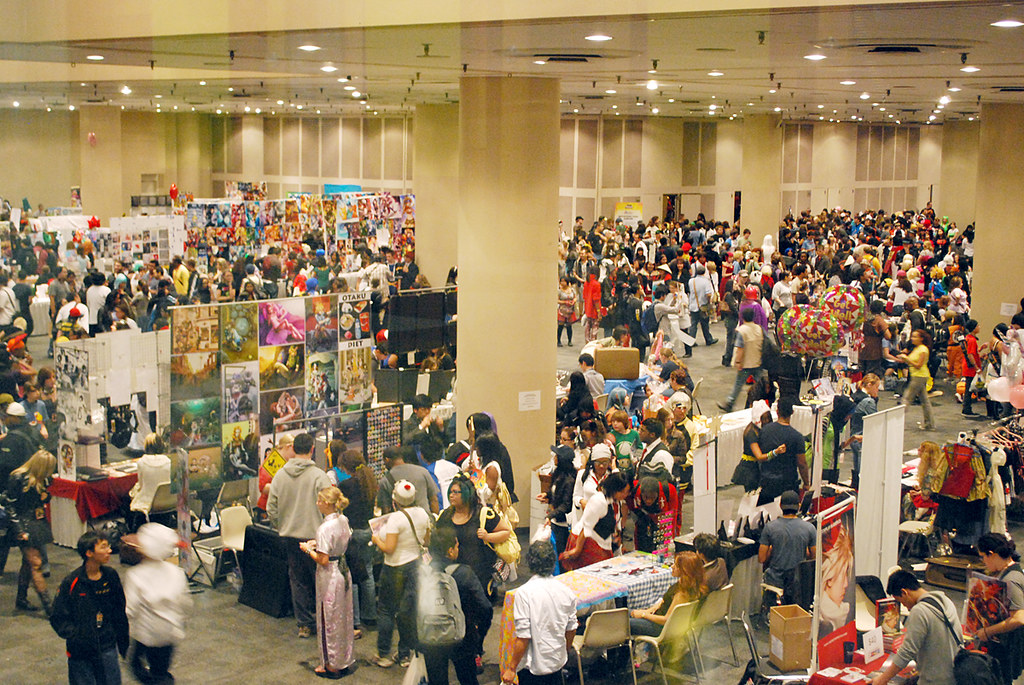
So while anime fans might enjoy the feeling of being "separate" from those "un-cool" comic fans down the hall, the inconvenience of having their anime-specific dealers right next to giant booths featuring Michael Jackson dancing games neutralizes any sense of uniqueness. Most anime fans spend the bulk of their time in the Dealer's Room at any convention, so the all the integration seems to have done is made it harder for everybody to move around the con by stuffing everyone in one Exhibitor's Hall. Additionally, the inconvenience of getting back to the anime hall — which featured a number of great panels and events — made it utterly impractical for anyone but the most hardcore con-goers. (In fact, one of my friends never stepped foot in the anime ghetto except to see the Gundam 00 movie premiere.)
I'm being very harsh on the convention, so to be fair I should point out that the programming itself was still top-notch at this year's NYAF. A number of East Coast anime gurus (the Reverse Thieves, Charles "Anime Anthropologist" Dunbar, the Ninja Consultants) ran fascinating panels, companies from FUNimation to Vertical to Bandai Entertainment held industry panels, and guests — both official and otherwise — like Masahiko Minami and Minori Chihara made NYAF's programming well worth checking out for fans both young and old.
On the non-anime side of things (which I only really got to experience through the Exhibitor's Hall), Comic Con continued to prove itself to be a stunning hub of pop culture for the East Coast. With giant video game booths, movie studios, local comic dealers, and independent artists, the show provided a little something for everyone, even if navigating the mass of shuffling shoppers and obnoxious cosplay photographers was often terribly frustrating.
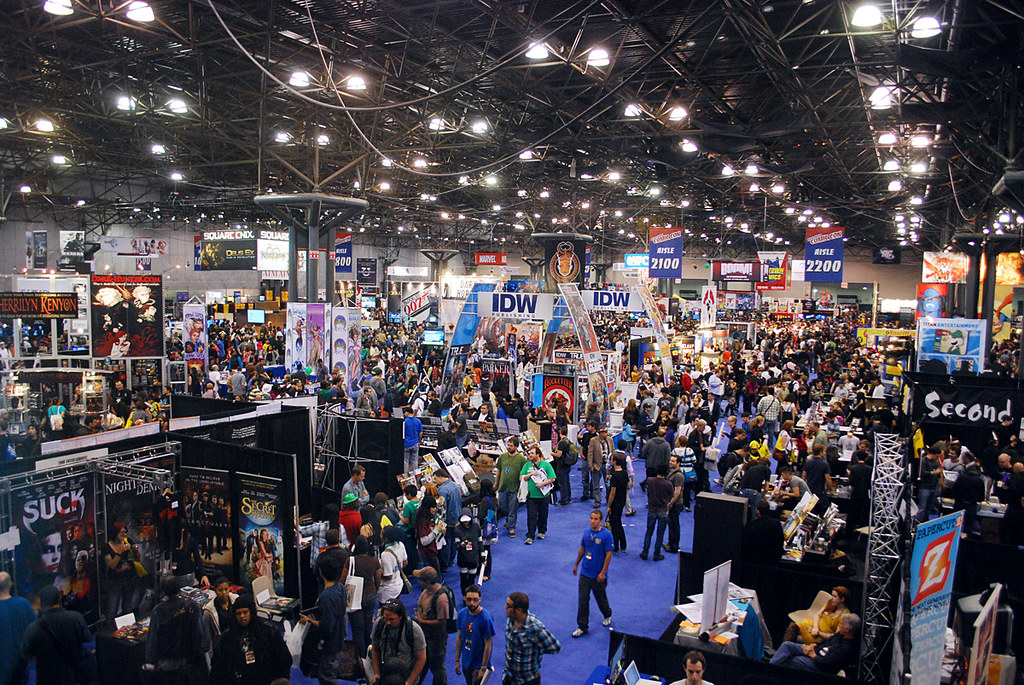
I only see two viable solutions to this problem, and both are bound to leave some people unhappy. One: completely integrate the two cons, essentially making it "New York Comic Con, but with more anime content than usual." Two: separate them into two different conventions at different times, just like previous years. The second option is not going to happen for obvious reasons (i.e. Reed has already committed to the combination), but the first option makes a lot of sense. If you're going to merge, go all the way. Anime fans will have to learn to be more mature in a con setting and Comic Con regulars will have to just suck it up when faced with the occasional (and often understandable) immaturity of teenage cosplayers.
Sure, young anime fans might be disappointed that they're not "special" anymore, but if you're screening things like The Disappearance of Haruhi Suzumiya and inviting guests like Minori Chihara, what are they going to do? NOT attend? Without another anime con competitor in the NYC area, I wouldn't count on it.
Special thanks to Jewels Lei for providing a fantastic photo gallery from both the Comic Con and Anime Festival, and Hisui of the Reverse Thieves blog for providing me with a roof over my head and a bed to sleep on over the weekend.
Click here for more of our New York Comic Con/Anime Festival 2010 coverage.
Continue reading... | Write a comment
|
|
NYCC 2010: Masahiko Minami (BONES President) Interview |

At the New York Comic Con/Anime Festival 2010 a few weeks ago, I had a rare chance to sit down with the co-founder and president of BONES anime studio, Masahiko Minami, thanks to the folks at Bandai Entertainment who had brought him to the convention. We discussed BONES' animation and production style, organizational culture, and history while touching on a few important series that Minami has worked on and talking over the future of the anime industry.
I'd like to thank Minami-san very much for taking the time out of his busy schedule for the interview, Bandai Entertainment Marketing Director Robert Napton for scheduling the interview, Aniplex translator Yosuke Kodaka for helping out with the translation on such short notice, and students Sarah Miura and Hiromi Kiuchi for their help in working out some of the more difficult-to-understand pieces of the translation after the fact.
Ani-Gamers: As a producer, how much of your job is creative, and how much of it is more business-oriented?
Masahiko Minami: As the president of BONES, I'm in charge of both the creative and the business side at the same time.
At BONES specifically, but also in your work at Sunrise, you worked on a lot of shows that eschew a distinctly Japanese aesthetic in favor of a fantasy, science fiction, or Western style. How have you found that that aesthetic affects the success of a series both in Japan and abroad?
So when I became a producer quite a long time ago, at the time, Japanese animation was becoming popular [around the world]. And basically, in my mind, my primary market was still in Japan. My attitude toward the fans is to provide a good thing first to the Japanese audience. But at the same time we are also aware of the overseas fans, so our primary market is in Japan but we are also aware of the broad, [worldwide] audience.
BONES seems to have made a pretty smooth transition from the age of cel animation to digital animation. Can you describe that process?
The title Angelic Layer (2001) was the first title [on which] BONES used digital [animation] after cels, and about then the creators were quite [insistent] on using those digital techniques. We tried [a lot of] trial-and-error to get the know-how; that is the first step in using digital [animation] after cels. It was a big challenge at the time.
So, at the [same time that] we were drawing Angelic Layer with the digital techniques, we had also a different line making the Cowboy Bebop (2001) movie with cels. So we were doing a kind of parallel [workflow] with digital and cel [animation] at the same time.

So onto a more specific question, Sword of the Stranger (2007) is a strange thing in this day and age: an anime film not based on a pre-existing franchise or brand. It is also a very traditional genre film, which is equally rare. Why did BONES decide to go through with the project?
At first, in my mind, [I thought that] BONES is very good at action series such as Cowboy Bebop (1998), Fullmetal Alchemist (2003), and Soul Eater (2008). [...] So the first concept that came to mind was to create a movie series with those producers [who are] really good at action series.
And that's why it's a historical series — a lot of series are using sci-fi, action, and laser beam [aspects]. Instead of that, we [wanted] to create a series about human beings, [with] a more natural kind of drama, so that is why we selected a historical theme.

It's a very good film by the way.
Thank you.
So, based on that fact, one more reason that we chose that historical age type of thing is that when we see The Lord of the Rings (2001) or The Chronicles of Narnia (2005), as Japanese we see that as a sort of fantasy, even though that is a historical type of thing, but also we thought that a Japanese [period piece] story would appeal as a fantasy to Western audiences.
You actually mentioned that BONES does a lot of action series, so I'm curious: what went into the decision to produce Ouran High School Host Club (2006), which is a very different turn for the studio?
[Laughs] Among the whole BONES line-up, Ouran is really a kind of strange series, actually!
The [BONES] producers are really good at action, but they [don't] tend to do just action series. [While] reading the original books, [they found that] they had lots of elements that appeal to a producer, [such as] a unique style of high school life (the host club), gathering up a team, and also supporting each other to kind of get a heart-warming kind of story. So that's why they selected it as a series.

Actually, I have a very specific question from one of my readers. He's a big fan of Ouran, and he was wondering why BONES made some of the changes to the story of the original manga.
In terms of the original story, when we were creating the animation, the original manga wasn't done, but as a TV series, we had to complete it in a certain time period [of] 26 episodes. [Thus] we had to make a complete story in 26 episodes.
Like Fullmetal Alchemist?
Yes.
Speaking of Fullmetal Alchemist, do you feel that the release of Fullmetal Alchemist: Brotherhood (2009) has changed the way that fans react to the original series?
So, as in Ouran, the previous Fullmetal Alchemist series has original factors, since the manga was not completed at that time. For Brotherhood, we were told that the manga series would be completed in the production period, so we decided to do a complete [anime] series based on the manga.
For Fullmetal Alchemist: Brotherhood, we tried to utilize the good points of the original manga as much as possible. We [worked on] in the project [from that standpoint].

How does the process of production differ when adapting a manga or other property versus creating an original property?
First, if we have an original story, not only a manga, but also a novel or other type of original material, we first find an appealing point, or [a way that] we can make it good when we adapt it to animation. So first we deeply research the original story, and then [figure] out how we can adapt it to animation.
For an original story, we have to create the screenplay and the basic story and setting as well, so when we create an original [property] we have to put in much more effort compared with a [series] based off of manga or novels.
And for the process of producing an original story, we have to think about the technique or imagination that the creator would like to put into the original story, and what kind of demand is now in the market from fans. We will deeply research in that field, and [utilize] our best knowledge about the animation techniques and story. So, we put everything in it for the original.
You've worked with Shoji Kawamori on both Vision of Escaflowne (1996) and Eureka Seven (2005). What do you think that he brings to the anime projects he works on?
[Laughs] It's an old relationship. I first met Kawamori-san when I was [working for] Sunrise, and I have a long relationship with him.
The two talents that Kawamori-san has are: (1) creating original stories and (2) mechanical design; in [terms] of that he is really talented. Also he always has the mind of a childhood boy.

If you could work on one anime or manga property past or present, what would it be? [After some miscommunication, this question was morphed into, "What is your favorite series, out of everything you've worked on?"]
No matter what, if it's based on a manga, or novel, or an original [story], I like all the titles that I get involved in like my children.
Yeah, I actually hear that a lot from creators.
[However,] among those, Fullmetal Alchemist especially is quite impressive, since we've done the same series twice. Also the series is very long (it's a "one year" and "two year" type of series), so Fullmetal Alchemist is kind of a impressive series among [everything I've worked on].
Your colleague Dai Sato recently spoke out against the concept of "Cool Japan," claiming among other things that the anime industry is now a "super establishment system." He argued that anime fans are losing their media literacy, and complained about something called "kuuki-kei" (atmospheric stories). Do you see any of those same problems, and if so do you see any viable solutions?
So... a title like K-ON! (2009)?
Yes, I think that was one of the ones Sato was complaining about.
I actually watched a couple of episodes from K-ON!, but I couldn't totally understand it.
So, after I watched a few episodes from K-ON!, I actually understood that atmosphere of appealing to fans — not that feeling, but the experience of [spending] time with a girl in [real] life. I understood those kinds of concepts myself. But I cannot make it, [at least not by] myself.

On that note, where do you tink BONES stands in terms of what kinds of anime series it creates, in terms of muzukashii-kei (difficult stories) or kuuki-kei? I think a lot of fans would probably say you are on the muzukashii-kei side.
[Laughs] In the current Japanese animation market, the trend is [moving] toward much more kuuki-kei series, and it's much easier to make money since we can see certain fans following that category. But at BONES, we are still discussing [ideas] with creators [in order to] compete with those series.
The title will [still] have to be identifiable, and there shouldn't be any similar series among the lineup. We create BONES titles [with the belief] that they should make the fans surprised with every title. That's our goal as a studio. When we created Ouran High School Host Club, Japanese fans were also surprised by it.
Do you feel that BONES has a specific style or tone to their series? A brand or mission statement maybe?
As I already mentioned, each title has to be identifiable, since when we make a similar type of series, it's kind of boring to fans. So like I said, it's not [that we] have a kind of a mission statement, or a theme among the series, actually, but I think each title has to be identifiable.
And it is kind of behind-the-scenes, but I put my effort into creating communication among people — the staff, fans, or other partners. I think that it is important to create that communication [in all of the series that I create].
It's interesting you said that you like to keep the series from being too similar. I think for a lot of fans there's a feeling that BONES series just feel different. People see a BONES series and they say "that's BONES, I can tell. That's not anybody else." So, is that intentional?
Actually, I am the president of BONES, but I am not a management-type person, so I am close to the creators. That's why my works are quite identifiable, and also surprise the fans every time. If I became a management-type person, maybe I would make more kuuki-kei titles to make money, but as a creator I like to create titles by myself. That's why our titles are identifiable, quality is high, and we surprise the fans every time.
That's all I've got. Thank you very much for your time, Minami-san!
Click here for more of our New York Comic Con 2010 coverage
Continue reading... | Write a comment
|
|
NYCC 2010: Lost in Shadow (Wii) Hands-on |

Last weekend, at the New York Comic Con, I had a chance to play through a few levels of a debug version of Lost in Shadow, a new platformer game for the Nintendo Wii, developed and published by Hudson Soft and directed by Osamu Tsuchihashi (designer for Dance Dance Revolution: Mario Mix, graphic designer for Mario Party 5-7).
Lost in Shadow follows a mysterious boy who, as we see in the first of its dialogue-free cinematics, has had his shadow cut away from his body by a dark, sword-wielding figure atop a tower. Now, the shadow, which has been thrown down to the ground and left without its memories, must climb to the top of the tower (which looks conspicuously similar to EVERYTHING from Shadow of the Colossus [2005]) to reunite itself with its original form. The twist: as the shadow, you can only interact with other shadows, not real objects.
The central gameplay mechanic will be instantly familiar to anybody who has ever played a traditional two-dimensional platformer. You run left to right along mostly horizontal surfaces, dodging arrows and enemies (which are also pure shadows without physical analogues, just like your character) in order to reach a door at the end of each level. In fact, according to the Hudson rep I spoke with, Tsuchihashi's primary inspiration for the mechanics was the original Prince of Persia (yep, the NES one).
However, what adds an interesting new dimension to the tried-and-true platforming formula of Lost in Shadow is the simple fact that most of the platforms are actually shadows of foreground objects projected on the background. Thus, the game actually forces you to rethink the way your character relates to the platforms he is standing on. Initially the only complexity lies in keeping your mind focused on the shadows despite changes in the objects casting them and the surfaces upon which they are cast, but later the game introduces areas called "Shadow Corridors" which feature more complex ideas like Echochrome-esque 90-degree perspective shifts and even three-dimensional movement.
Just playing as a shadow without any effect on the real world rather limits your options, however, so Hudson includes another character, a small fairy-like creature called a sylph who floats by your side but can become your Wiimote pointer at any time to help you past obstacles. Her main function is to find objects that can be energized and then moved, creating new shadow shapes for you to climb over, but there are some particularly mind-bending sequences where she can be used to move a light source, thus stretching all of the shadows on screen and making it possible to heavily modify the entire shadow landscape.
Some of the individual pieces have been used before (especially the cliché "ruinous fantasy adventure" aesthetic), but the overall effect of Lost in Shadow is quite striking in its novelty, and makes for an experience full of wide-eyed surprise as you are forced to rethink many of the basic physical properties of the platformer genre. Watch out for this innovative title when it hits North American stores on January 4, 2011 and look out for a full Ani-Gamers review in the near future.
Click here for more of our New York Comic Con 2010 coverage
Continue reading... | Write a comment


