Quantcast
Showing posts with label CoMix Wave Inc.. Show all posts

Showing posts with label CoMix Wave Inc.. Show all posts

Review: Hoshi o Ou Kodomo – Children Who Chase Lost Voices From Deep Below (Sub)

7 comments

Hoshi o Ou Kodomo: Children Who Chase Lost Voices From Deep Below

Medium: Anime Film
Director: Makoto Shinkai
Studio: CoMix Wave, Inc.
Genre: Adventure, Fantasy, Romance
Distributor: Media Factory (JP)
Release Dates: May 7, 2011 (JP), July 30, 2011 (US)
Age Rating: Not Rated (contains gun and sword fights, but minimal bloody violence)

I've said it before and I'll say it again: Makoto Shinkai is the Green Day of anime.

I used to make this half-joking comparison between the newcomer anime director and '90s punk revival band since both of them make "the same great song over and over." But little did I know that Shinkai's newest film would fulfill the other part of the Green Day prophecy: the moment they stop making the same song, everybody gets angry that they stopped.

Hoshi o Ou Kodomo (localized as the comically verbose subtitle, "Children Who Chase Lost Voices From Deep Below") is just that moment — Shinkai's American Idiot if you will. It is a distinct break from his typical teen angst stories and a foray into magical action-adventure. The transition isn't too smooth, either for viewers or the director himself, but Children — the fourth film in Shinkai's catalog — is still a beautiful work, and one that hopefully heralds a new period in his career.

12-year-old Asuna is living alone with her workaholic mother following her father's untimely death, but despite a healthy school life she spends most of her time up on the nearby mountain, listening to whatever radio signals she can pick out on her crude ham radio. However, a dangerous run-in with a giant monster in the woods results in a friendship with a mysterious boy named Shun. Thus begins Asuna's adventure into the ruined underground world of Agartha.

You might already be sensing a bit of an influence here, and no, you're not mistaken. Makoto Shinkai has openly expressed his admiration for the works of Studio Ghilbi, particularly Laputa (Castle in the Sky), which made a big impression on him when he saw it as a boy. And while imitation is the sincerest form of flattery, Shinkai — almost certainly accidentally — leaves the realm of homage and heads straight into the no-man's land of full-on copying. Oh look, there's the Forest King from Princess Mononoke, the cave shelter from Grave of the Fireflies, the fox-squirrel from Nausicaa, the architectural style of Castle in the Sky!

A Quetzalcoatl, one of the enigmatic gods that rule Agartha

Shinkai's touch is definitely there, and one need only pay attention to the director's masterful use of watercolor-esque lighting and color to understand that this is not straight-up imitation, but I still feel like there's a little bit too much Miyazaki and not enough Shinkai in the film. His trademark brooding, silent moments are still there, but they are interspersed with action scenes and fast-paced plot developments.

And boy oh boy, those action scenes! I was sure surprised to find that a director whose last outing was characterized by long stretches of waiting silently on a train can create such lightning-fast, exciting action sequences. The film's moments of gunfire and hand-to-hand combat have a sort of whipping speed and kineticism that I've seen only in some of the best action anime directors (and of course, Mr. Miyazaki). Shinkai claims his team studied both Ghilbi movies and the Rurouni Kenshin anime in order to figure out how to animate the scenes.

Children hits all the emotional points that you might expect from the director of Voices of a Distant Star, The Place Promised in Our Early Days, and 5 Centimeters Per Second, but one too many deus ex machinas and a few too many different set pieces bog down the pacing to what feels like a crawl. Shinkai has got to learn to edit if he's going to attempt another movie in this vein.

Shun's brother Shin, whom Asuna meets partway through the story

But let's make this clear: I would love for Shinkai to try another movie like this. It's a distinct break from his previous work, and while it's more of a so-so Ghilbi film than a great Shinkai film, it is enough of a proof of concept to hook me for the rest of his work. As long as he learns from his mistakes and doesn't get stuck in the rut of re-making this exact movie over and over, this director could really go places. He's got emotional expression down better than basically anybody else in the business, and now has proven his mettle in the realm of action scenes. A little bit more editorial oversight will probably do wonders for honing his style.

Is he still the Green Day of anime? Yeah, probably. Is he "the next Miyazaki?" That still remains to be seen, but Children is certainly a fine down payment towards the title.

[Recommended]


This review is based on the Otakon 2011 premiere screening. The reviewer was given a complimentary press pass for the convention.


Click here for more of our Otakon 2011 coverage

Continue reading... | Write a comment

Review: 5 Centimeters Per Second (Sub)

3 comments

5 Centimeters Per Second: a chain of short stories about their distance Medium: Anime Film
Genres: Drama, Romance
Director: Makoto Shinkai
Studio: CoMix Wave Inc.
Licensed? No

If there was ever such a thing as animated poetry, Makoto Shinkai would be a master poet. Emotions of all kind swell with the rising tides, whipping winds, and falling snow in his beautiful, poignant 2007 film 5 Centimeters Per Second. The movie, which is subtitled "a chain of short stories about their distance," follows the simple story of a boy named Takaki Tono and a girl named Akari Shinohara. They meet when they're young and remain friends through elementary school, but are forced to go their separate ways when Akari moves to a new town. The two stay in contact through letters, but as the story progresses, they drift further and further apart. This sad story is told in a three-act structure: part one follows Tono as a middle schooler, part two as a high schooler, and part three as a working adult.

While some would classify this as a romance, in truth 5cm (as I will call it from here on out) is a sort of character study of Takaki Tono. It follows him throughout his life as his separation from Akari changes him more and more. While Shinkai's strength doesn't seem to be in characters as much as plot, he makes up for it by choosing a small number of characters to focus on. Side characters like family members and friends are rarely brought up, so the focus remains on Tono, Akari, and Kanae Sumida (a girl who Takaki meets while in high school).

5cm is emotional and heart-wrenching in part because it deals with simple, universal issues. A boy and girl meet, fall in love, and are forced to leave each other. These are things that cross cultural contexts, and understanding this, Shinkai weaves a story that is neither melodramatic nor unrealistic. Bad things happen beside good things, and a single overarching plan for the film is never clear. It's truly like watching someone's life unfold; we feel Tono's pain alongside his momentary joys.

Tono waits on the train to meet Akari (Part 1)

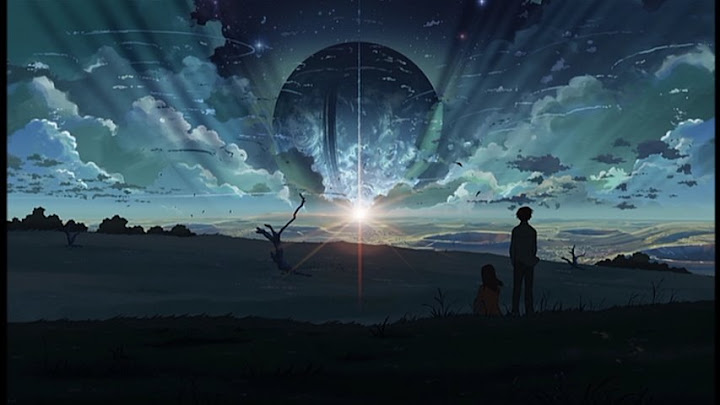
Of course, the plot would be nothing without 5cm's soaring visuals. Shinkai loves the sky, so he never misses an opportunity to show someone staring up at the clouds, the stars, or the sunset (one of the most common motifs in the film). As such, 5cm maintains a consistent aesthetic throughout, as Shinkai shows repeated visions of snow, cherry blossoms, and incredible sunsets. If nothing else, Tono and Akari are brought together by these things of nature. They live side by side, running on parallel tracks through snow, rain, and wind.

And no review of 5cm can be written without saying that everything, from trains to clouds to birds, is beautiful in this masterpiece. This is mostly thanks to Shinkai's deft weaving together of perfectly crafted modern scenes (trains and cars) and pastel-like nature scenes. Without a doubt this is the best-looking anime that I have ever seen.

In the final five minutes of the third act, Tono thinks back on his experiences, and Shinkai chooses not to use a simple monologue (as he has for most of the film). Instead, he trots out an evocative, unexpected montage of scenes from parts one and two, all backed by a pop song that perfectly sums up the pained longing that Tono has felt throughout his life. The montage even weaves in scenes that the audience hasn't seen yet, filling in the gaps that viewers missed due to the three-act structure. Even though Shinkai's use of a quick-cut music video feels a little off in such a slow-paced movie, it manages to bring forth the themes of the film in a mere three minutes, and leaves the audience to watch the final minute of Tono's story with his entire life laid out before them.

A scene from Part 2: Cosmonaut

The final scene is a poignant yet simple moment that provides perhaps the best highlight of Shinkai's minimalistic attention to detail. Every whispered line of dialogue and every ray of light shining across a snow-covered train car is placed for its impact on the viewer. There is nothing extraneous in the tightly-wound plot of 5cm - everything in the film contributes to bringing the viewer closer to Tono's joys and pains.

5cm does indeed have a strange structure that might throw some people off. Additionally, the narration switches from Tono to Kanae to Tono in parts one, two, and three, and the montage scene at the end is a little jarring. While these changes might confuse some viewers, they lend uniqueness, and in the case of the POV switch, it gives the audience a momentary chance to see the introspective Tono as viewed from the outside.

Makoto Shinkai has written a poem here in the pastel colors of the evening clouds. He has shown a man's life in the sunrise that crests a green-crowned hill. He has carved a work of art into the snow beneath a frozen cherry tree. 5 Centimeters Per Second is a resounding achievement of Japanese animation. A film of such uncompromising quality should not and cannot be left to collect dust in the annals of anime history.


excellent.

Continue reading... | Write a comment

Recent Posts